
Rebuilding a 17-year-old family print business online: what changed, what didn't, and what the ads account cost us
The Prints Plus has printed walls in Surat since 2008. In 2025 it became a proper online store with a see-it-on-your-wall preview, product feeds and a rescued ads account. This is the whole story, numbers included.
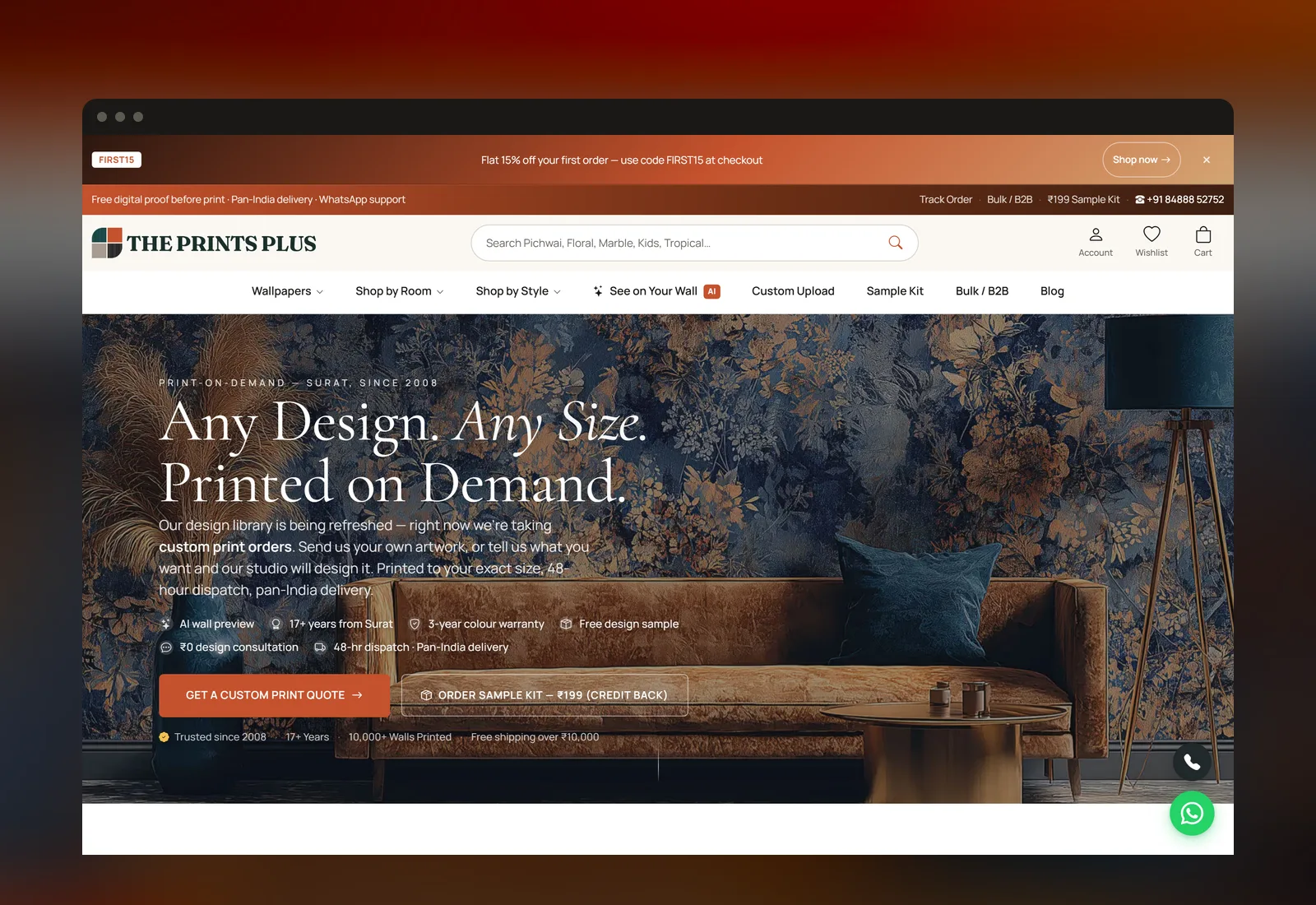
My family has printed walls in Surat since 2008. Wallpaper, canvas, acrylic, the large-format kind of print that ends up in a hotel lobby or a child's bedroom. For seventeen years the business ran on phone calls, WhatsApp photos and a workshop that everyone in the trade knew and nobody online could find. In 2025 I rebuilt it as an online store. It is now the fourth entry in my product ledger, and the one I'm asked about most, because every founder I talk to has a family business somewhere that 'should really be online'.
This is what that actually involved. Not the pitch version. The version with the ads account suspension, the product feed that rejected four hundred items, and the month where the new site got traffic and no orders.
What was there before
A workshop that could print anything at any size, a reputation among interior designers in Gujarat, a WhatsApp number that had been shared ten thousand times, and no way for a stranger in Pune to buy a wallpaper at 11 p.m. The product was excellent. The distribution was a phone that only rang during business hours.
The instinct with a business like this is to 'put the catalogue online'. That's what the first two agencies the family had spoken to proposed. It's the wrong frame. A catalogue is a list. A store is a promise: this design, this size, this price, delivered by this date, and here's what it looks like on your wall before you pay.
The store: three decisions that mattered
Custom sizing had to be first-class
Most wallpaper stores sell rolls. We print to the wall. So the product page asks for width and height first, prices the exact wall, and only then shows finish options. That single choice removed the biggest source of confusion in the old WhatsApp flow, where half the conversation was working out how many rolls a wall needed.
See it on your wall
The thing nobody believes until they try it: a customer can photograph their wall and see the design on it before ordering. I built the preview because returns on wallpaper are brutal for a printer. You can't restock a wall. Preview-before-purchase cut the 'it looked different' conversations to almost nothing, and it turned out to be the feature people share.
The promises on the homepage are real, and enforced
Free digital proof before print. Forty-eight-hour dispatch. Three-year colour warranty. Every one of those is a workshop process with a person responsible, not a marketing line. I refused to put anything on the site that the workshop couldn't keep on a bad week. The site is only as good as the Tuesday after Diwali.
Product feeds: where the first month went
To advertise products on Google and Meta you need a feed: a structured list of every product with images, prices, availability and about thirty other attributes. Our catalogue had hundreds of designs, each in multiple finishes, each at custom sizes. The first feed submission rejected roughly four hundred items for reasons ranging from image size to a missing shipping attribute to a title that Google's classifier decided was misleading.
Fixing the feed was three weeks of unglamorous work. It was also the single highest-return thing in the whole project, because once the feed was clean, every product became a searchable, shoppable listing across Google's surfaces without paying for a click. If you take one thing from this piece for your own family business: get the feed right before you spend a rupee on ads.
The ads account, and what it cost
The business had an existing ads account from an earlier attempt with an agency. It was suspended. Circumventing systems, according to the notice, which is the label platforms use when they can't be bothered to be specific. Getting it back took six weeks, three appeals, a full rebuild of the landing pages to match the policies to the letter, and a lot of patience with a support system designed to make you give up.
It was worth it because a suspended account poisons everything attached to it. A new account under the same business would have inherited the suspicion. Once reinstated, and with a clean feed behind it, shopping campaigns started producing orders at a cost that made sense within the first month.
A catalogue is a list. A store is a promise. The site only earns the promise if the workshop can keep it on a bad week.
What changed for the business
- Orders now arrive from cities the family has never visited. The phone still rings, but it rings about orders that already exist.
- The workshop's day starts with a printed queue instead of a scroll through WhatsApp.
- Interior designers, who were always the best customers, now send clients a link instead of a photo.
- The see-it-on-your-wall preview became the thing people mention when they refer the business.
What didn't change, on purpose
The workshop still answers WhatsApp. The number is on every page. Some customers will always want to talk to a person before spending on a wall, and the site's job is to make that conversation shorter, not to eliminate it. I've watched other family businesses go online and lose the thing that made them good, which was that someone picked up. We kept that.
The part behind the store: the print house's own system
A storefront that takes orders is only half of it. The other half is what happens at 9 a.m. when forty orders need to become a print queue, a set of proofs, a delivery list and an invoice. The workshop had been running on a notebook and memory. So alongside the store I built the shop's own operations system: quote to job to invoice, with the pricing slabs the family had carried in their heads for seventeen years finally written down. It's not glamorous, it's used every day, and it's the reason the workshop can promise forty-eight-hour dispatch to a stranger in another city without a phone call.
The single biggest change it made: the person who prints no longer needs to ask the person who sold. The job carries its own instructions. That one fact removed more friction than the whole storefront.
The numbers I can share
- Ten thousand-plus walls printed over the life of the business; the site made the number visible for the first time.
- Custom-size orders now outnumber standard sizes, which was the opposite of what the family expected. People want the exact wall.
- The see-it-on-your-wall preview is used on a majority of product visits that convert, and by almost nobody who bounces. It's the strongest signal we have of intent.
- The reinstated ads account pays for itself; the feed-driven free listings do better than that.
What I'd do differently
I'd start the feed and the ads-account appeal on day one, in parallel with design, instead of after. Both are slow processes run by systems that don't care about your launch date, and they set the floor for everything else. I'd also photograph more walls earlier. The best-converting images on the site are not renders, they're real rooms in real Surat homes with the print on the wall and the family's own furniture in front of it. We had seventeen years of those. We just hadn't been taking the photo.
The site is live at theprintsplus.com. If you have a business like this in your family and want it built the same way, the brief form on the front page reaches me.

Product builder from Surat. Ships his own apps, runs live broadcasts, and takes on a few founders a year for product, brand and growth. hey@jaybutani.com