
Unknown Callers Now Show a Name in India. It's the Name on the SIM, Not the Caller
From 1 November 2026, Indian phones show a name under unknown numbers on 4G and 5G calls, on by default. That name comes from the KYC form filled in when the SIM was bought, so a SIM bought with someone else's papers shows someone else's real name. What the name is, what it doesn't cover, how to check the SIMs on your own ID, and what callers see in the US and the UK.
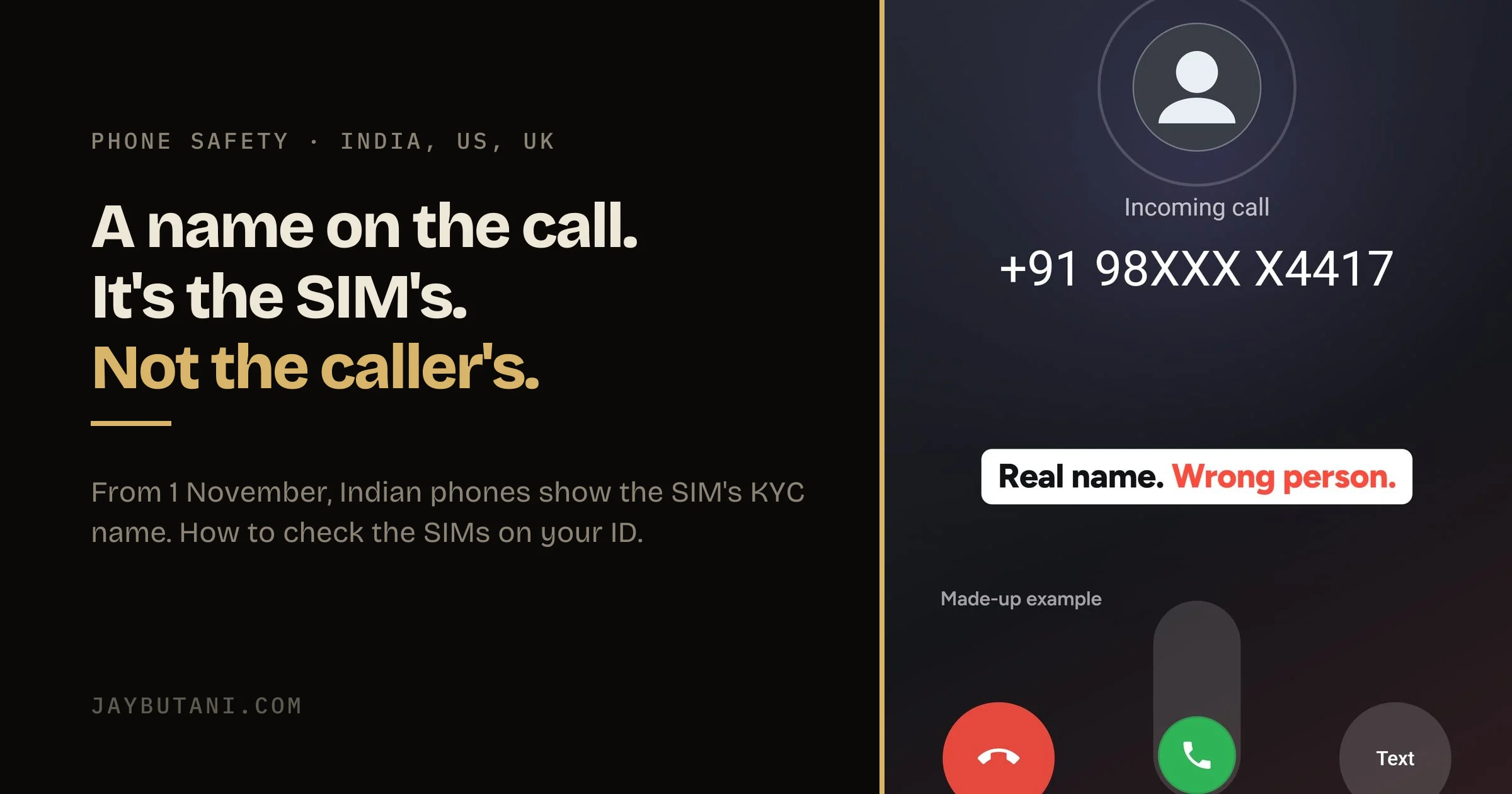
Your mum's phone rings. An unknown number, but this time there's a name under it: Sunita Sharma. A name feels safe, so she picks up, and the caller says he's from her bank.
From 1 November 2026, India's operators show a caller's name on 4G and 5G calls. It's called Calling Name Presentation, or CNAP, and it's on by default. The catch is where the name comes from. It isn't the person calling. It's the name on the form filled in when the SIM was bought.
What changed on 1 November
The Department of Telecommunications (DoT) told operators on 13 October to start CNAP in every service area from 1 November, as News On AIR reported it. Users don't have to ask for it.
The service will be provided to all users without requiring a separate request.
— News On AIR, 15 October 2026
For now it covers 4G and 5G calls. 2G, 3G and landlines will be considered separately. A number you've saved still shows the name you saved, and an unsaved call from abroad shows "International Call".
Where the name comes from
The name is the one the caller's operator recorded when the SIM was bought, during KYC. TRAI's 2024 recommendation says the same: use the name the subscriber gave in the Customer Application Form.
the name recorded by the caller's operator at the time of the Know Your Customer (KYC) process
— ThePrint, 15 October 2026
So the name belongs to the SIM, not to whoever holds the phone. A son on his dad's SIM shows up as his dad. A company SIM can show the company. And a SIM bought with someone else's papers shows that person's real name, which is exactly the name a scammer would want on your screen.
It also isn't Truecaller. Truecaller's names come from its users' contact lists. CNAP's come from the operator's records.
What to do
- Treat the name as a label, not proof. A bank, a courier or the police calling with a familiar name is still a stranger until you've called them back on a number you found yourself.
- Check the SIMs on your ID. On sancharsaathi.gov.in, open "Know Mobile Connections in Your Name" and mark any connection you don't know as "Not my number". Connections reported that way are disconnected by the operator.
- Report the call. Chakshu, on the same site, takes reports of suspected fraud calls and messages.
- If money is gone, call 1930, India's cyber fraud helpline, or file at cybercrime.gov.in.
The US, the UK and everyone else
In the US, many phones show a check mark on some calls. It means the number wasn't faked, under a system called STIR/SHAKEN. It doesn't say who is calling, and the FCC itself says people may read it wrong.
STIR/SHAKEN information does not provide consumers with robust information about who is calling
— FCC 25-76, adopted 28 October 2025
In the UK, caller ID is a number, and Ofcom's rules say it has to be a valid, dialable one. There's no KYC name. Anywhere else, report fraud at econsumer.gov.
FAQ
When does caller name display start in India?
DoT told operators to start it in all service areas from 1 November 2026, on 4G and 5G calls, without users having to ask for it.
Whose name does CNAP show?
The name the caller's operator recorded at KYC, from the Customer Application Form filled in when the SIM was bought. It's the SIM owner's name, which isn't always the person calling.
Can I switch it off?
No switch-off steps have been announced. DoT said in 2025 that a user could ask to disable it, but reports on the 2026 circular say it doesn't mention an option.
How do I check which SIMs are on my ID?
On sancharsaathi.gov.in, use "Know Mobile Connections in Your Name". You can mark any number you don't know as "Not my number".
This is the long version of Phone Safety #01, a reel for @buildjayy on Instagram about changes to the phone in your pocket. If you're building an app, send me the word BUILD there, or start with the brief form on the front page.
Sources: News On AIR, 15 October 2026, on the DoT order, the start date, default-on, the networks covered and international calls; ThePrint, 15 October 2026, on the KYC name and the switch-off; TRAI's recommendation of 23 February 2024 on the Customer Application Form; TRAI's response of 28 October 2025, quoting DoT on disabling it; Beebom, 15 October 2026, on 4G and 5G and on Truecaller; Sanchar Saathi; FCC 25-76; and Ofcom on calling line identification.
- 2 Nov 2026
- Published, with the reel.
Product builder from Surat. Ships his own apps, runs live broadcasts, and takes on a few founders a year for product, brand and growth. hey@jaybutani.com