
UPI Gets a Fee After Diwali. Who Pays It, What Stays Free and Where the ₹10 Goes
A ₹2,500 UPI payment at a shop costs the shop nothing today. After Diwali it can cost the shop ₹10. NPCI set a 0.4% fee on shop payments above ₹2,000 in September and moved the start to right after Diwali. You still pay ₹0. What stays free, how the fee is split between banks and apps, and how it compares with what a shop pays in the US and the EU.
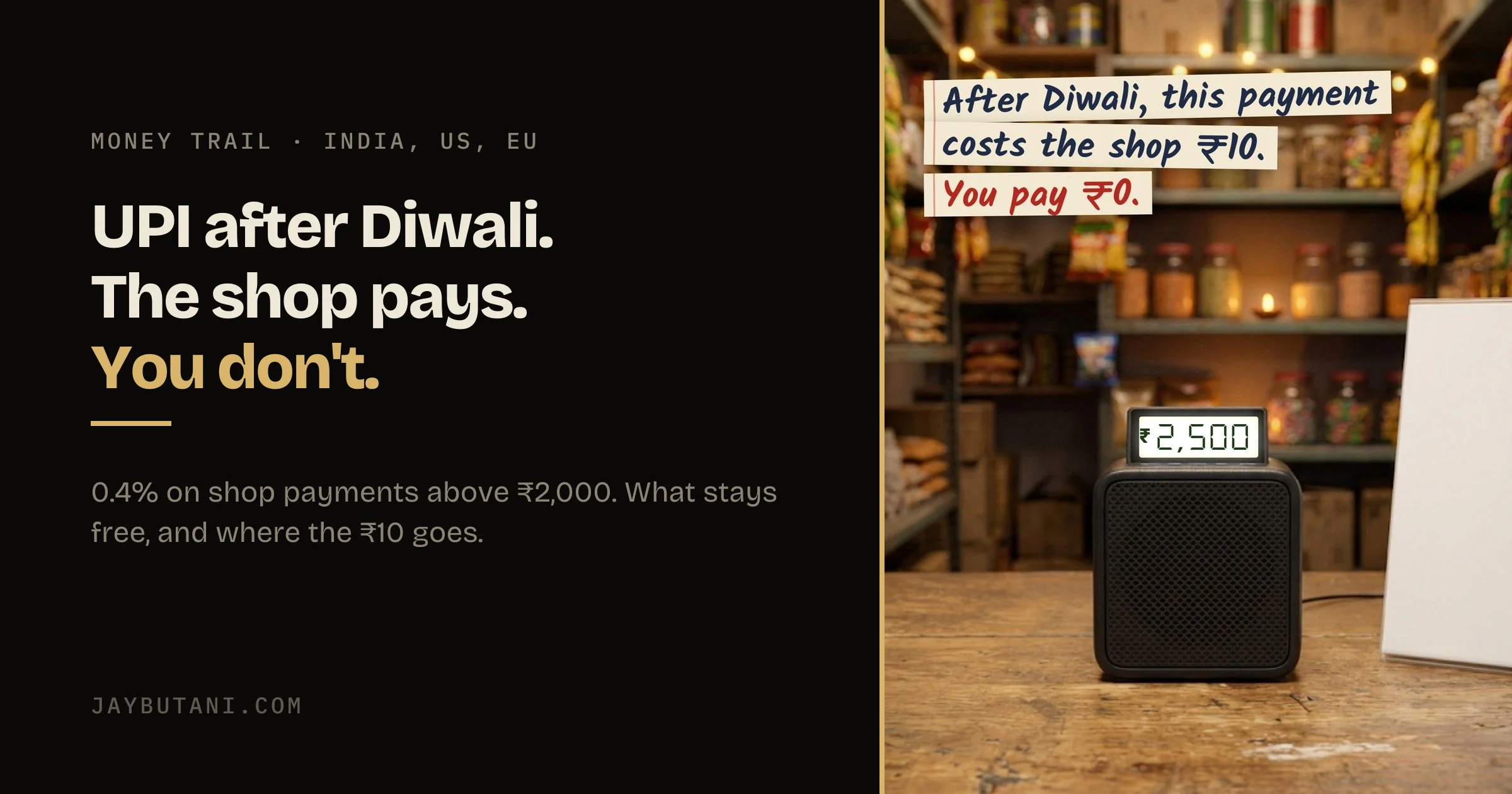
A customer pays ₹2,500 at a kirana counter by UPI, and the speaker on the counter reads out the amount. Today that payment costs the shop nothing. After Diwali it can cost the shop ₹10.
The ₹10 is a merchant discount rate, or MDR: the fee a shop pays to accept a payment. UPI hasn't had one since 1 January 2020. In September the National Payments Corporation of India (NPCI), which runs UPI, set one at 0.4% on shop payments above ₹2,000. It was due on 15 October. On 13 October NPCI moved it to right after Diwali, on a date it hasn't announced yet.
What changes after Diwali
The fee is 0.4% of a shop payment above ₹2,000, capped at ₹300 once a payment reaches ₹75,000. Railways, telecom, insurance, fuel and a few other categories pay a flat ₹5 instead. This is how the public broadcaster reported the Finance Ministry's statement.
A nominal MDR of 0.4 percent will be levied on person-to-merchant transactions above 2,000 rupees, while for high-value transactions of 75 thousand rupees and above, MDR will be capped at three hundred rupees per transaction.
— News On AIR, on the Finance Ministry's statement, 16 September 2026
The start date is the open question. NPCI's statement on 13 October said the fee will start immediately after Diwali, on a date to be notified separately. Diwali is on 8 November. As of 29 October, no date had been announced.
What stays free
- Every shop payment up to ₹2,000. The Finance Ministry puts that at about 96 in every 100 shop payments. That's counted by number of payments, not by value.
- Every transfer to a person. Sending money to a friend or family member has no fee at any amount.
- Small shops. Shops receiving up to ₹1 lakh a month through UPI QR stay at zero, whatever the payment size.
And the fee is the shop's to pay, not yours.
The Ministry said that banks have been advised to ensure that merchants do not pass Merchant Discount Rate (MDR) charges to customers for UPI payments.
— News On AIR, 16 September 2026
Where the ₹10 goes
On a ₹2,500 payment the fee is ₹10. The Finance Minister set out the split on 25 September, as PTI reported it.
| Who gets it | Share | Of ₹10 |
|---|---|---|
| Your bank, the customer's | 40% | ₹4 |
| The shop's payment gateway | 30% | ₹3 |
| The UPI app you paid with | 20% | ₹2 |
| That app's sponsor bank | 10% | ₹1 |
The ₹2 is the line to watch. Since 2020 a UPI app has had no fee from a payment like this. PhonePe handled 45.57% of UPI payments in September 2026, by NPCI's count, and its filings show a loss of ₹2,792 crore in the year to March 2026. Its money comes from elsewhere: commissions on bills and recharges, its payment gateway, soundboxes, loans and insurance. This fee is new money on top. It's small on one payment. UPI carried 24.07 billion payments in September alone.
How it compares with the US and the EU
The US has no UPI. A shop pays a fee on every card tap, and on a credit card that's 1.5% to 3.5% in total, by the Richmond Fed's count. On a debit card the Federal Reserve caps the bank's part at 21 cents plus 0.05%, for now: an appeals court struck that cap down on 26 October, and the ruling doesn't take effect until the court issues its mandate. Venmo, the closest US app to UPI, is free between friends and charges business profiles 1.9% plus 10 cents.
In the EU the bank's part of a card fee is capped at 0.2% for debit cards and 0.3% for credit cards, under Regulation (EU) 2015/751. That cap covers one part of what a shop pays, so it isn't a like-for-like match with UPI's 0.4%, which is the shop's whole fee. What is clear: 0.4% on bigger payments sits far below what a US shop pays to take a credit card.
What to do
- If you pay by UPI: nothing changes. If a shop asks for extra because you're paying by UPI, that's the thing banks have been told to stop.
- If you run a shop: check your monthly UPI total. Under ₹1 lakh a month on QR, you stay at zero. Above it, only payments over ₹2,000 carry the fee.
- If you build an app that takes UPI: put 0.4% on payments above ₹2,000 into your pricing and your margin maths now, before the date is announced.
The exception: if your app only takes small payments, under ₹2,000 each, the fee doesn't touch you.
FAQ
When does the UPI fee start?
NPCI said on 13 October 2026 that it will start immediately after Diwali, on a date to be notified separately. Diwali is on 8 November 2026. As of 29 October no date had been announced.
Do customers pay the UPI fee?
No. The shop pays it. The Finance Ministry says banks have been advised to make sure merchants don't pass it on to customers, and transfers between people stay free at any amount.
How is the 0.4% split?
40% to the customer's bank, 30% to the shop's payment gateway, 20% to the UPI app and 10% to the app's sponsor bank, as the Finance Minister stated on 25 September 2026.
This is the long version of Money Trail #01, a reel for @buildjayy on Instagram about where the money in everyday payments goes. If you're building an app that takes payments, send me the word BUILD there, or start with the brief form on the front page.
Sources: News On AIR, 16 September 2026, for the Finance Ministry's statement (rate, cap, exemptions, flat fees, the 96% figure and the pass-on rule); PTI via ThePrint, 13 October 2026, for the deferral; PTI via Deccan Chronicle, 25 September 2026, for the split; the Income Tax Department for zero MDR from 1 January 2020; MediaNama and Entrackr, citing NPCI, for September's share and volume; Outlook Business, citing PhonePe's filings, for its loss; the Richmond Fed, the Federal Reserve and Ballard Spahr for US card fees and the court ruling; Venmo's fees page; and the European Parliament's summary of Regulation (EU) 2015/751 for the EU caps.
- 31 Oct 2026
- Published, with the reel.

Product builder from Surat. Ships his own apps, runs live broadcasts, and takes on a few founders a year for product, brand and growth. hey@jaybutani.com