
Three Checkout Tricks That Have Now Cost Companies Money: a Pre-Ticked ₹10, a Scary Button and Amazon's $2.5 Billion
A ₹999 course costs ₹1,009 at checkout because of a box you never ticked. India fined PhysicsWallah ₹5 lakh for it in June. The same order fined McAfee over a renewal screen that made saying no look dangerous, and in the US Amazon agreed to pay $2.5 billion over Prime. How each trick works, what the regulators said in their own words, and where to report one in India, the US or anywhere else.
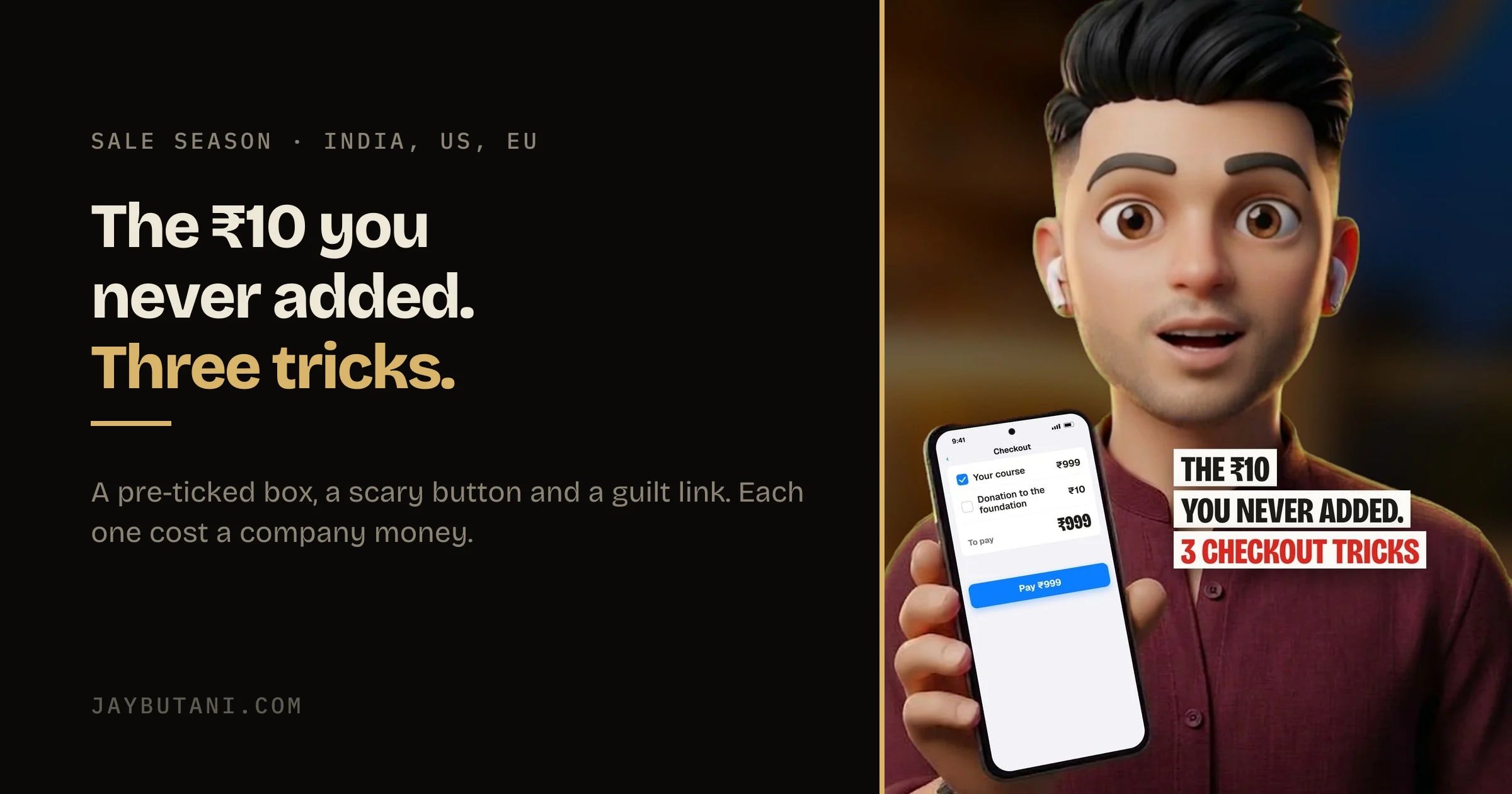
You buy a ₹999 course. At checkout the total says ₹1,009. Somewhere above the Pay button there's a ₹10 donation, and its box is already ticked. You didn't tick it.
That box cost PhysicsWallah ₹5 lakh. PhysicsWallah is an Indian coaching company that is listed on the NSE, where it was worth about ₹38,000 crore (roughly $4 billion) on 28 October 2026. India's Central Consumer Protection Authority (CCPA) fined it in an order the government announced on 3 June 2026, the same order that fined McAfee ₹1 lakh for a different trick. In the US, Amazon agreed in September 2025 to pay $2.5 billion to settle the FTC's case over how it signed people up for Prime. Three tricks, three regulators, one idea: make the choice the company wants the default, and make the other one feel wrong.
Trick 1: the box that ticks itself
PhysicsWallah's checkout added a ₹10 donation to its foundation by default. This is the finding as the Press Information Bureau published it.
A donation of ₹10 to the PW Foundation was automatically selected during checkout and added to the total payable amount without the consumer's explicit consent.
— PIB release 2268302, 3 June 2026
Unticking it wasn't the end of it. The same release says consumers 'were shown emotional messages related to children's education, healthcare and marriages, encouraging them to keep the donation selected.' The reel shows that step as a recreated sheet. The real screen isn't reproduced anywhere here.
The regulator's answer is one sentence, and it's the one worth remembering.
Consumer consent cannot be assumed through pre-selected options and must always be obtained through a clear and affirmative action.
— PIB release 2268302, on the CCPA order
The fine was ₹5 lakh. In the EU the same box has been against the rules since June 2014, when the Consumer Rights Directive started to apply. The Commission's own summary lists 'a prohibition to use pre-ticked boxes on websites for charging extra payments'. The UK brought in the same rule that month through its consumer contract regulations.
Trick 2: the scary button
McAfee's renewal screen offered two choices: Renew Now, or Accept Risk. Letting a subscription end isn't a risk in any ordinary sense. Calling it one is the trick. From the same release:
Users were prominently shown two options - "Renew Now" and "Accept Risk" effectively portraying non-renewal as a risky decision.
— PIB release 2268302
That finding cost McAfee ₹1 lakh. Once you've seen the pattern it's hard to miss. A big coloured button for the choice the company wants. A small grey one, worded to make you feel careless, for the choice you came to make.
Trick 3: the button that shames you
To skip Prime during checkout, Amazon's button read 'No, I don't want Free Shipping.' Nobody doesn't want free shipping. That's the point of the wording.
On 25 September 2025 the FTC announced a settlement with Amazon over Prime: a $1 billion civil penalty and $1.5 billion in refunds, which the FTC says gives full relief to an estimated 35 million consumers. This is how the FTC describes the case.
…settling allegations that Amazon enrolled millions of consumers in Prime subscriptions without their consent, and knowingly made it difficult for consumers to cancel.
— FTC, 25 September 2025
Those are allegations Amazon settled, not findings from a trial. The button, though, is gone by order.
Amazon can no longer have a button that says, “No, I don’t want Free Shipping.”
— FTC, 25 September 2025
Why it works on people
₹10 feels like nothing, and most of us never read the full bill. A pre-ticked box turns not paying attention into consent. A scary button turns an ordinary choice into a risk. A guilt line turns no into a small moral failure. None of them lie about the price. They change what doing nothing means.
What to do at checkout
- Open the full bill before you pay. Untick anything you didn't add yourself.
- Read the small button. If the choice you came to make is the grey one with the odd wording, you've found the second trick.
- If saying no feels scary or rude, slow down. That feeling was put there.
The exception: a fee that's shown up front, like delivery on the first screen, isn't one of these. The problem is the extra you only find at the end, or never.
Where to report one
| Where you are | Report it to |
|---|---|
| India | National Consumer Helpline, 1915 |
| US | ReportFraud.ftc.gov |
| Anywhere else | econsumer.gov, run by consumer protection agencies from dozens of countries |
If you build a shopping app
Leave every extra unticked and put the full price on the first screen. Make the decline as easy to find as the accept, and word it plainly. 'No thanks' is enough. It costs a little conversion. It costs less than a fine.
FAQ
Why was PhysicsWallah fined ₹5 lakh?
India's CCPA found that a ₹10 donation to the PW Foundation was automatically selected during checkout and added to the total without the consumer's explicit consent, and that people who tried to remove it were shown emotional messages. The order was announced on 3 June 2026.
What did Amazon agree to pay the FTC?
$2.5 billion, announced on 25 September 2025: a $1 billion civil penalty and $1.5 billion in refunds to settle allegations that it enrolled people in Prime without their consent and made cancelling difficult. Amazon can no longer use a decline button that says 'No, I don't want Free Shipping.'
Where do I report a checkout trick?
In India, the National Consumer Helpline on 1915. In the US, ReportFraud.ftc.gov. Anywhere else, econsumer.gov, which is run by consumer protection agencies from many countries.
This is the long version of a reel for @buildjayy on Instagram. If you're building an app and want a checkout people trust, send me the word BUILD there, or start with the brief form on the front page.
Sources: PIB release 2268302, 3 June 2026, for the CCPA order and every quote about PhysicsWallah and McAfee; FTC press release, 25 September 2025, for the Amazon settlement, the amounts and the button, read again on 28 October 2026; the European Commission's page on the Consumer Rights Directive and its consumer factsheet for the EU rule; NSE (symbol PWL) for PhysicsWallah's market value on 28 October 2026, converted at RBI's reference rate of ₹95.2278 to the dollar. The phone screens in the reel are recreations of the patterns these orders describe. Stock video in the reel: Mixkit.
- 29 Oct 2026
- Published, with the reel.
Product builder from Surat. Ships his own apps, runs live broadcasts, and takes on a few founders a year for product, brand and growth. hey@jaybutani.com