
Why I Built jaybutani.com: Personal Branding for a One-Person Software Shop in India
168 followers on X, nine products, one name. Why a personal website beats a portfolio, a LinkedIn and an App Store page for a builder who works alone, and how this one was made.
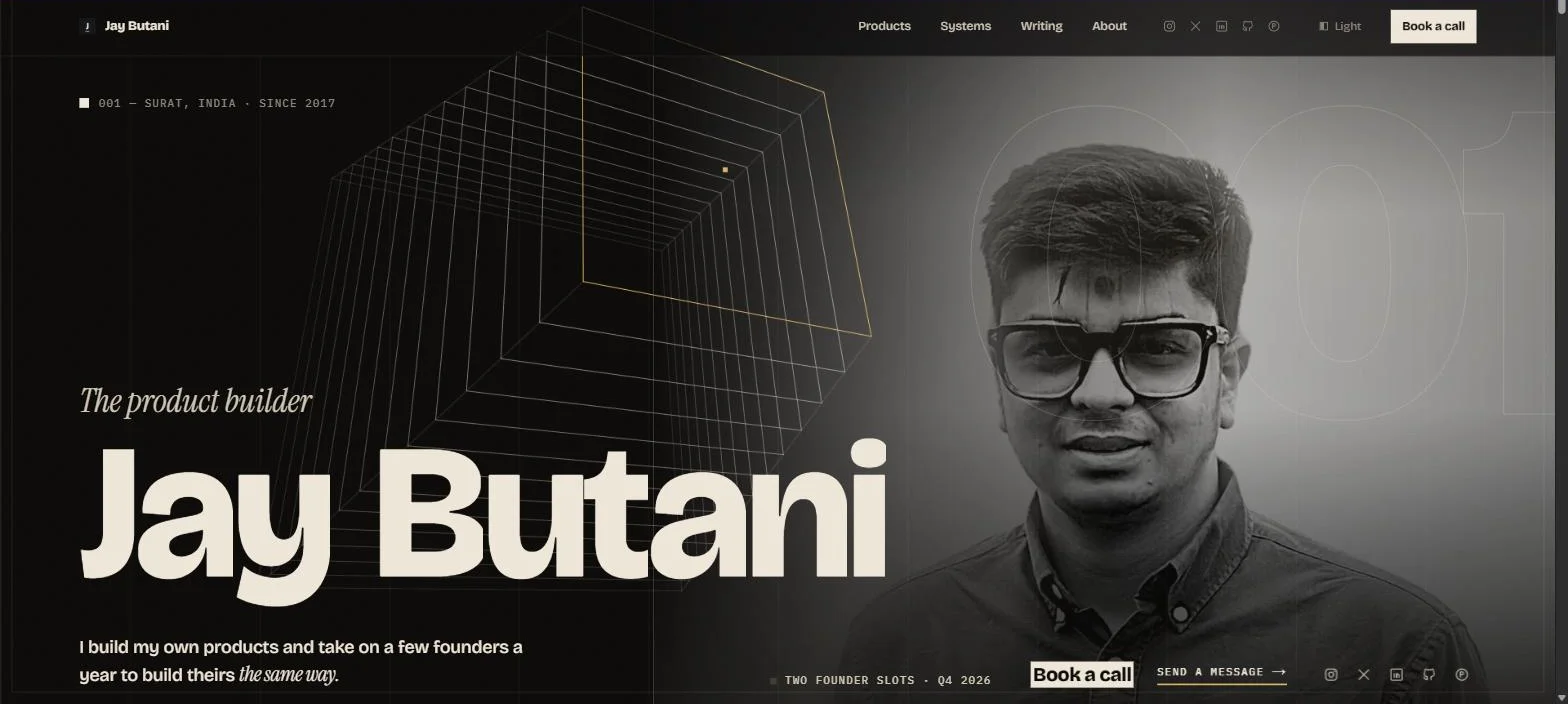
I have 168 followers on X after 918 posts. I've shipped nine products, three of them earning on the App Store, one of them a 17-year-old family business that now sells online. Until this year there was no single place where a stranger could see that list. That is why this site exists, and this post is the long version of the reason.
It is also a working answer to a question I get from other developers in India: whether a personal website is worth the weekend when you already have a GitHub, a LinkedIn and an App Store page. Mine says yes, for reasons that have nothing to do with looking professional.
What I had before the site
Five App Store and Play Store listings, each with its own name and none mentioning the others. A family business at theprintsplus.com that a customer would never connect to an iOS developer. A studio site, Harimurti Technologies, that did client work under a company name. A Guinness World Record broadcast in 2022 that existed as a certificate on a wall in Vadodara and nowhere online. And WhatsApp, where every actual conversation happened.
The problem was not that any of it was hidden. It was that nobody could see the shape. A founder who found ShotPop had no way to know the same person built a print ERP, ran a live broadcast system for a hall, and had a hundred thousand dollars of App Store revenue behind them. Each piece looked like a small thing done by a small shop. Together they are the argument for one accountable person owning product, brand and growth, which is the only thing I actually sell.
That argument does not survive being split across six URLs.
What personal branding means when you work alone
Most of what gets called personal branding is performance: a headshot, a tagline, a posting schedule, a point of view rented from someone with more followers. For a one-person software shop the useful version is narrower and more boring. It is a public record of what you shipped, with dates and numbers, kept honest.
The rule this site runs on: every item has a status. Live, Shipped, In build, or In use. Nothing gets to be vaguely in progress. ShotPop is live on the App Store. Arth is in build, App Store 2026, and it says so. Knife Throw Royale shipped years ago and is still earning, so it says shipped rather than live, because I am not actively working on it. A status is a promise about the next time you look.
The second rule: numbers stay in. $100k+ lifetime on the App Store from three apps, zero investors. 5,000+ installs for Celeste on Google Play. 10,000+ walls printed by The Prints Plus. 27 hours, 27 minutes, 27 seconds for the Guinness broadcast. Numbers are what make a claim checkable, and checkable is the whole point of putting your name on it.
The third: mistakes are listed first. The pricing decision I got wrong for three years is in the App Store post before the revenue chart is. A brand built on a record of being wrong and fixing it is harder to knock over than one built on a highlight reel.
What is on the site and why each part exists
- Products
- The five things I own: ShotPop, Celeste, The Prints Plus, Knife Throw Royale, Arth. Each with one plain sentence, a status, and a link to the store. No stack names anywhere on the page, on purpose. A founder does not care that it is SwiftUI.
- Systems
- The broadcast and show-control tools built for live events: TempleCast, CrewCue, vMix Helper, ATEM Tally, Media Desk. Work that has no app store listing and would otherwise be invisible.
- Operations
- Client systems, anonymised where the client prefers: an import operations desk for a manufacturer, a print ERP, a warehouse ERP with WhatsApp updates, a care platform across two campuses for 100+ residents. Proof that the same person can build the boring, load-bearing software too.
- Sites and brands
- Storefronts and brand sites shipped for others: Fanture, Zentika Pharma, Harikrishna Events. Small section, but it answers the question a founder asks first: can this person make the thing look right.
- Writing
- Nine long-form posts as of today. This is the part that compounds. Everything above is a list; the writing is the evidence.
- Start a project
- One form, one email, two founder slots a quarter. The site's only ask.
How it was built
Designed first, as a canvas: ten versions before the one that shipped, which the repo still calls Champagne Master. The palette is a dark ink with bone type and one gold, and there is a light mode because people read on phones in daylight. The hero stays dark in both, which was a deliberate call: the first screen is the poster, the rest is the document.
Built in Next.js 15, deployed as a container on a VPS I already ran for other projects, behind the same reverse proxy. No CMS. Posts are typed data in the repo, which means a post cannot be published while it still contains an unfilled placeholder, because the build refuses. That guard exists so a half-written post cannot go live by accident.
Most of the code was written with Claude Code, the same tool I wrote about the limits of last week. The design came out of Claude Design. One person, a few evenings, and a lot of arguing with the model about image pipelines. I say this plainly because a personal site that hides how it was made is already lying a little, and the whole page is meant to be a record.
What it cost in money: a domain and a share of a server I was paying for anyway. What it cost in time is the honest number, and it was more than a weekend. Getting the social cards, the structured data, the sitemap and the changelog blocks right took as long as the design.
Writing is the engine, not the decoration
The lists on the home page get someone to the site once. The writing is what brings search traffic, and it is what a founder reads before deciding whether to book a call. So the writing has rules that are stricter than the rest of the site.
- Every number links to where it came from. If it cannot be sourced, it is cut.
- Posts about things that have not happened yet use scheduled language, not certainty, and say so. The Claude Code limits post was written the day before a change and had to be right whichever way the change went.
- Every post has a changelog at the foot and a visible updated date. A post about a moving target that does not move with it is worse than no post.
- First-hand evidence over aggregation. My own
/usagescreenshot beats a table copied from a pricing page. My own test of five Meta apps on iOS 27 beats a rumour. - No claims about my own week that I cannot show. If I did not test it, the post says it was not tested.
Two of the nine posts went up this month and were updated within 48 hours because the facts moved. That is the pattern the site is built for. The Writing Tools post still has a table marked pending, in public, because the honest state of that test is pending.
What the site is actually for
Three audiences, in order of how much they matter to the business.
Founders who want one person to own product, brand and growth rather than a developer, a designer and a marketer who do not talk to each other. Two slots a quarter. The site is the whole pitch; the call is the close.
People who use the products. Someone who finds ShotPop in the App Store and wants to know who made it should land on a page that answers that in one screen, and shows the other things the same person keeps running. Trust is transferable when the record is visible.
Other builders in India who are three years behind where I am and want to see what the path looked like with the numbers left in. That is the audience that reads the long posts to the end. They do not book calls. They share.
The personal branding rules I actually follow
- One name. Not a studio name, not a brand name, not a handle. The studio exists and has its own site; the person is what a founder hires.
- Status on everything. Live, shipped, in build, in use. Nothing floats.
- Specific over impressive. ₹1,64,900 is better than expensive. 168 followers is better than growing. 27:27:27 is better than record-breaking.
- Mistakes first. The wrong lesson, the pricing I held for three years, the nine days I did not notice a bug. Listed before the wins, every time.
- Build in public is customer support, product research and distribution in one. It is not marketing. The X account is where that happens day to day; the site is where it gets written up properly.
- Update or delete. A page that is out of date is a liability with your name on it. Changelogs are the fix.
- Ship the site like a product. Structured data, social cards, sitemap, performance, a working form. If the site is sloppy the products are assumed sloppy.
What is next
Arth ships in 2026. The founder slots for Q4 are open. And in December I am at GITEX Global in Dubai for the expo, which is the first time this site gets used the way it was designed to be: something to point a stranger at in a crowded hall and say, that is all of it, pick the one you want to talk about.
The day-to-day is on X. 168 followers, and every one of them got there by reading something specific.
FAQ
Does a developer need a personal website in 2026?
If you ship things under your own name, yes. A GitHub shows code, LinkedIn shows a feed, an App Store page shows one product. A personal site is the only place where every piece of work sits together with a status and a date, and the only place you can publish long-form writing that ranks and stays current.
What should be on a personal website for a developer or indie founder?
A list of what you have shipped with a live, shipped or in-build status; numbers where they exist; a writing section with sourced, dated posts; one clear way to contact you; and structured data, social cards and a sitemap so search engines and social platforms read it properly.
Is personal branding worth it with a small audience?
Yes, because the site is not for the audience you have, it is for the person who lands on it once from search or a store listing and decides in a minute whether to trust you. 168 followers on X is small. A page that shows nine shipped products with dates is not.
What was jaybutani.com built with?
Next.js 15, deployed as a container on a self-managed VPS. Designed in Claude Design across ten versions and built largely with Claude Code. Posts are typed data in the repository rather than a CMS, with a build guard that refuses to publish a post containing an unfilled placeholder.
How do I work with Jay Butani?
Two founder slots a quarter for product, brand and growth under one accountable name. Email hey@jaybutani.com or use the Start a project form on the site.
Sources: the site itself, jaybutani.com, for every product, system and number listed; the posts linked inline for the App Store revenue, the Guinness broadcast and the print business; @buildjayy for the follower and post counts, read on 16 September 2026. Cover is a screenshot of the home page, my own.
- 16 Sep 2026
- Published.

Product builder from Surat. Ships his own apps, runs live broadcasts, and takes on a few founders a year for product, brand and growth. hey@jaybutani.com