
SEO in 2026 When Google Answers the Question Itself: How a Small Site Still Gets Found
Google Search fell from 9% to 5% of publisher pageviews in two years, and AI Mode now ends most searches on Google's own page. Here is what still sends people to a small site, the exact SEO setup on this one, and the two mistakes I found in it while writing this.
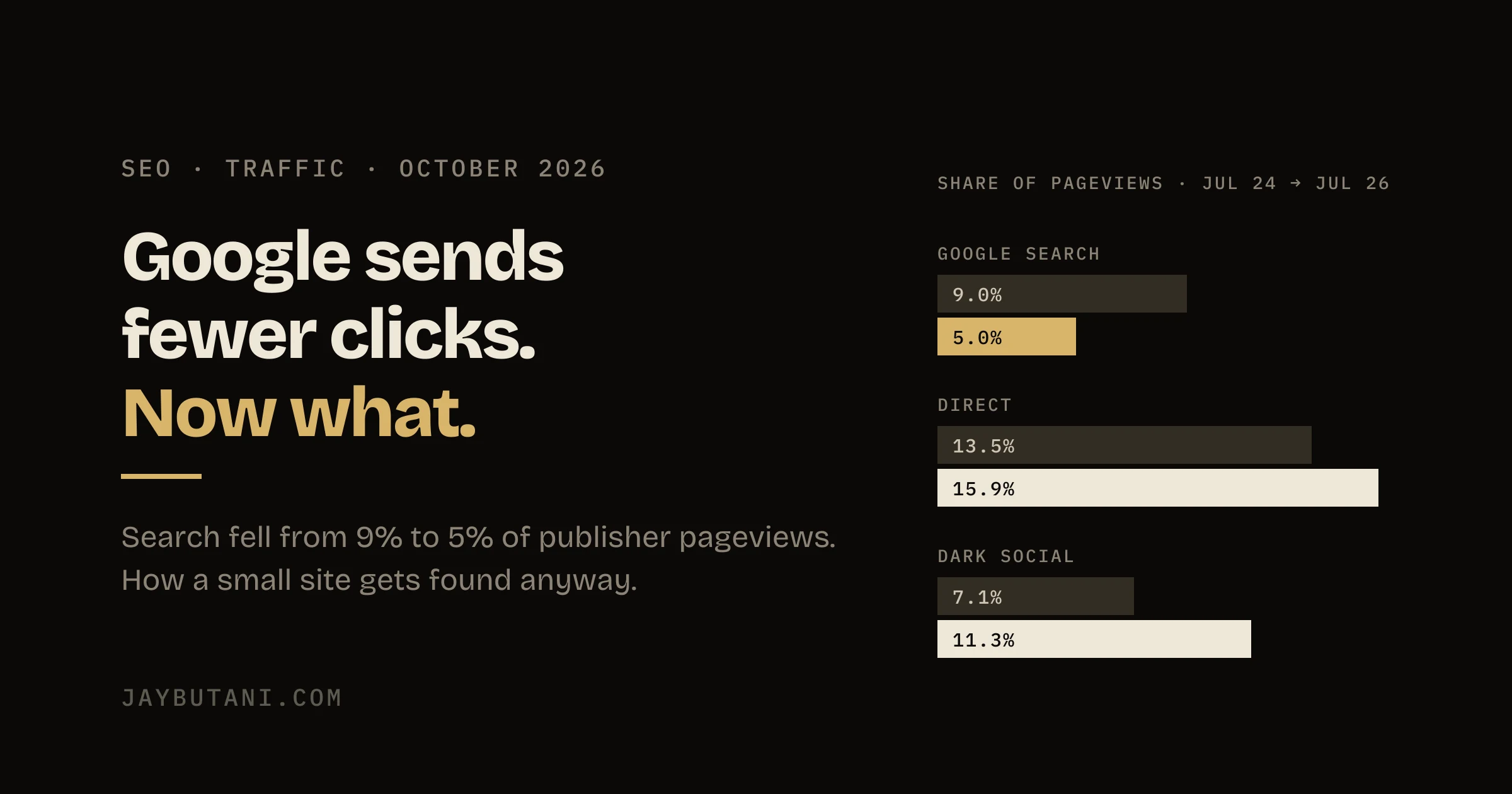
Chartbeat's 2026 Publisher Playbook, reported by Search Engine Journal on 24 September, puts Google Search referrals to its publishers down 40.2% between July 2025 and July 2026. The year before, the drop was 21.9%. Search went from 9% of all their pageviews to 5% in two years.
This site went live in September. It's a one-person site with thirteen posts and no ad budget, which is exactly the kind of site that was told for fifteen years that search would carry it. So this is the plan for getting found anyway, written down with every setting that's actually in the repo, and the two that were wrong.
Two mistakes I found writing this
Rules on this site say mistakes go first, so here they are.
The sitemap lied about updates. Every post has an updated date, shown on the page and sent in the structured data as dateModified. But the sitemap was sending the publish date as lastModified. So when the Claude Code limits post was revised two days after it went up, the sitemap told Google nothing had changed. Fixed today: the sitemap now sends the updated date.
llms.txt was four posts behind. The file that tells AI assistants what the site is listed 5 posts out of 11. Nothing broke, which is why nobody noticed. It now lists all thirteen, with the newest first.
Both were the same kind of bug. Something written by hand once, next to something generated, drifting apart quietly. The fix in both cases is the same: generate it or check it at build time.
What changed in search this year
| Source of pageviews | July 2024 | July 2026 |
|---|---|---|
| Google Search | 9.0% | 5.0% |
| Direct | 13.5% | 15.9% |
| Dark social (DMs, messaging apps) | 7.1% | 11.3% |
| Internal (one page to the next) | 37.9% | 40.4% |
| AI assistants | 0.01% |
Google Discover fell too, 34.3% year on year after a 6.6% drop the year before. And AI assistants, for all the talk, sent 0.01% of traffic. ChatGPT and Perplexity are not replacing the clicks Google stopped sending. They're barely sending any.
The reason is on Google's own page. Time reported on 29 September that AI Overviews now appear on 40% of US searches, that AI Mode has passed a billion monthly users, and that Google has moved its 'Ask Anything' bar out from behind a 'Show more' button. Time also cites an Ahrefs study linking AI Overviews to a 58% drop in clicks to the top results.
The caveat is in the table caption. Chartbeat measures news sites. A news site loses most when Google can summarise the story. A small site in a niche loses less, or differently. The direction is still the same for everyone.
What Google says to do about AI Mode
Less than you'd think. Google's page on AI features and your website says this:
There are no additional requirements to appear in AI Overviews or AI Mode, nor other special optimizations necessary.
— Google Search Central
To be cited as a link in an AI answer, a page has to be indexed and eligible to show with a snippet. That's the same bar as a normal result. Clicks from AI features are counted inside the ordinary Web search numbers in Search Console, and Search Console doesn't split them out. And Google claims clicks from pages with AI Overviews are 'higher quality', meaning people stay longer.
So the technical work hasn't changed. Anyone selling a separate 'AI SEO' checklist for Google is selling the old one with a new name. What has changed is which pages are worth writing.
What still earns a click
An AI answer is good at the average of what's already been written. It is bad at three things, and those three are the whole content plan for this site.
- First-hand evidence. A screenshot of my own
/usagemeter, revenue numbers from my own App Store apps, a 27-hour broadcast I ran. A summary can mention it. It can't be it, so the reader clicks. - Facts that move. Prices, limits, dates. A post that's right on the day and gets a changelog entry when the facts change beats the summary, which was trained on last month's version. The limits post was written the day before a change and updated within 48 hours.
- A name. People search for a person they trust after they've read them once. Branded search is the one kind AI Mode doesn't eat, because the answer to 'Jay Butani ShotPop' is a link.
What loses is the post that restates documentation. 'What is Full Disk Access' gets answered on Google's page. 'Your terminal already has it, here's the test' gets clicked, because the test is the content. Today's Full Disk Access post is written that way on purpose.
Build for the traffic that is growing
Look at the table again. Three sources went up: direct, dark social and internal. Each one has a thing you can build.
Dark social is WhatsApp. In India especially, a link gets shared into a group and nobody sees where the click came from. What decides whether that link gets tapped is the preview card. Every post here has its own 1200 by 630 share card, rendered from the post. Where the photo isn't mine, the credit is set into the artwork, because the card travels without its caption.
Internal traffic is the next post. 40% of publisher pageviews come from one page to another. Every post here ends with Next in the ledger and links inline to the posts it builds on.
Direct traffic is memory. People type a URL they remember. One name, one domain, a reason to come back. The changelog on every post is that reason. It's also why the site has a status next to every product: a status is a promise about the next time you look.
The exact SEO setup on this site
Everything below is in the repository. None of it needs a plugin.
- Titles and descriptions
- Each post has a full headline and a separate search description of about 155 characters. The dek on the page is usually too long for a snippet, so it isn't reused.
- Article structured data
- BlogPosting JSON-LD on every post: headline, description, word count, section, keywords, author with links to every social profile, and the lead image in 16:9, 4:3 and 1:1, which is what Google's Article guidance asks for.
- Dates with a time zone
- Posts are dated in IST. A bare 2026-10-06 gets flagged by Google as missing a time zone, so dates go out as 2026-10-06T00:00:00+05:30.
dateModifiedcomes from the updated date, and so does the sitemap, as of today. - FAQ markup from the visible FAQ
- The FAQPage JSON-LD is built from the FAQ block on the page, so the markup and the answers a reader sees can't drift apart.
- Share cards
- Open Graph and X cards per post, plus the two cropped variants for structured data.
- Crawlers
- robots.txt allows every search engine and sixteen named AI crawlers, from GPTBot and ClaudeBot to PerplexityBot and Applebot-Extended. Only the form endpoint is blocked. Being cited by an assistant is worth more than the 0.01% of traffic it sends, because the citation is the brand.
- llms.txt
- A plain-text summary of who I am, what I've built and every post, for assistants that read it.
- Canonicals
- Every page declares its own canonical URL. Drafts are reachable for review but marked noindex and kept out of the sitemap.
- Speed, measured from real visits
- LCP, CLS and INP are recorded from real readers and sent to analytics, because that field data is what Search Console judges, not a lab score.
- A build that refuses bad posts
- A post can't be published while it contains an unfilled placeholder. The build fails instead.
Measuring it when Google hides the query
Google sends the search term as '(not provided)'. Search Console is the only place to see it, and it lumps AI Mode clicks in with everything else. So the site's own tracking does the splitting Google won't.
- Engine and surface. A visit from Google Discover behaves nothing like one from a search result, so every organic visit is tagged with which engine and which surface: web search, Discover, News or Images.
- AI assistants as their own channel. Clicks from ChatGPT, Perplexity, Claude, Gemini and Copilot are counted as
ai_assistantinstead of disappearing into 'referral'. Today's number for that will be tiny. It's tracked so the day it isn't tiny is visible. - The post that earned the lead. When someone fills in the project form, the first post they read that session is attached to the enquiry. That's the only SEO metric that pays for anything.
This post doesn't publish the site's traffic numbers. A month of Search Console data from a new domain says more about indexing than about anything I did. They'll go in the changelog here once there's a quarter of data worth reading.
The checklist for a small site
- Write what a summary can't. Your own test, your own numbers, your own screenshot. If an AI answer could replace the whole post, don't write it.
- Date everything and keep the dates true. Updated date on the page, in
dateModifiedand in the sitemap. The same date in all three. - Put a changelog on posts about moving targets. It's a reason to come back and a signal that the page is maintained.
- Do the boring technical basics once, properly. Titles, a real search description, Article structured data with three image ratios, canonicals, a sitemap. Google says there's nothing extra for AI Mode. Believe it.
- Make the share card good. WhatsApp and DMs are where links travel now. The card decides the tap.
- Link your posts to each other. Internal traffic is the biggest single source on the Chartbeat table. A reader who finishes one post should have an obvious next one.
- Let AI crawlers in. They send almost no traffic. Being named in an answer still puts your name in front of the person asking.
- Measure the lead, not the visit. Track which post a client read first. Traffic that never becomes a conversation is a vanity number.
FAQ
Is SEO still worth it in 2026?
Yes, but for different pages. Google Search sent publishers 40% fewer visits in the year to July 2026, per Chartbeat, mostly because AI Overviews and AI Mode answer the question on Google. Pages with first-hand evidence, current numbers and a recognisable author still earn the click.
How do I optimise for Google AI Mode and AI Overviews?
Google says there are no additional requirements or special optimisations. A page needs to be indexed and eligible to show with a snippet, the same as a normal result. AI feature clicks are counted in Search Console's Web search numbers.
How much traffic do ChatGPT and Perplexity send to websites?
Very little so far. In Chartbeat's 2026 data, AI referrals were 0.01% of publisher pageviews. Being cited still matters for brand, so it's worth letting AI crawlers in.
What is dark social traffic?
Visits from links shared in private channels such as WhatsApp, Telegram, Slack and DMs, which arrive with no referrer and look like direct traffic. It grew from 7.1% to 11.3% of publisher pageviews between July 2024 and July 2026 in Chartbeat's data.
What SEO setup does jaybutani.com use?
Per-post titles and 155-character descriptions, BlogPosting and FAQPage structured data, dates with an IST time zone, a sitemap that uses each post's updated date, per-post share cards, robots.txt open to search engines and sixteen AI crawlers, an llms.txt file, and real-user Web Vitals tracking.
Sources: Search Engine Journal, 24 September 2026, for every Chartbeat figure; Time, 29 September 2026, for AI Overviews coverage, AI Mode users and the Ahrefs click-through figure; Google Search Central, AI features and your website, last updated 10 December 2025, for Google's guidance. Every part of this site's setup described here is in its repository, read on 6 October 2026.
- 6 Oct 2026
- Published. Same day: sitemap switched to each post's updated date, llms.txt brought up to all thirteen posts.
Product builder from Surat. Ships his own apps, runs live broadcasts, and takes on a few founders a year for product, brand and growth. hey@jaybutani.com